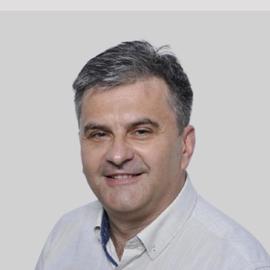
Dinko Vukadinović
Full Professor | Department of Power Electronics and Control
University of Split - FESB
dinko.vukadinovic@fesb.hr
Dinko Vukadinović was born in 1973 in Banja Luka. In 1993, he enrolled the Faculty of Electrical Engineering, Mechanical Engineering and Naval Architecture (FESB) in Split to study Electrical Engineering, specializing in Electric Power Engineering. He graduated in 1997 with a major in Industrial Electrical Engineering and Automation and received the Rector’s Award of the University of Split for outstanding academic achievements in the academic year 1995/96.
In 1998, he began his career as a research assistant at FESB in Split, and in the same year, he enrolled the postgraduate program in Electrical Engineering at the Faculty of Electrical Engineering and Computing in Zagreb. In 2002, he defended his master’s thesis entitled “Estimation of state variables of a vector-controlled induction motor”. He completed his PhD in 2005 at FESB and defended his thesis titled “Rotor speed estimation of a vector-controlled induction motor using a neural network”.
In 2008, he founded the Power Electronics Research Laboratory at FESB, where he is actively involved in its work and modernization. Throughout his career, he has led two competitive scientific research projects, including one funded by the Croatian Science Foundation from 2017 to 2021.
Under his supervision, three PhD theses were written and defended in the fields of control of electrical machines and power electronics converters. These theses contain the results of experimental research carried out in the Power Electronics Research Laboratory at FESB. From 2009 to 2022, he held the position of Head of the Power Electronics and Automation Laboratory.
His scientific interests include modern control systems for controlling power electronics converters, electric motors and electric generators.
Courses:
- Control Engineering
- Power Electronics
- Electronic Converters for Power Supplies
- Control of Electric Machines
- Power electronics converters
- Control of induction motors and generators
- Control of switched reluctance generators
- Fuzzy logic
- Integration of battery systems in microgrids
PhD in Power Engineering, 2005
Faculty of Electrical Engineering, Mechanical Engineering and Naval Architecture
MSc in Power Engineering, 2002
Faculty of Electrical Engineering and Computing in Zagreb
MEng in Power Engineering, 1998
Faculty of Electrical Engineering, Mechanical Engineering and Naval Architecture