International Conference on Smart Systems and Technologies (SST)

Evaluating the Impact of Sellback Rates and Metering Schemes on Battery Storage Size in Grid-Connected PV Systems - Prof. Damir Jakus, PhD
Abstract
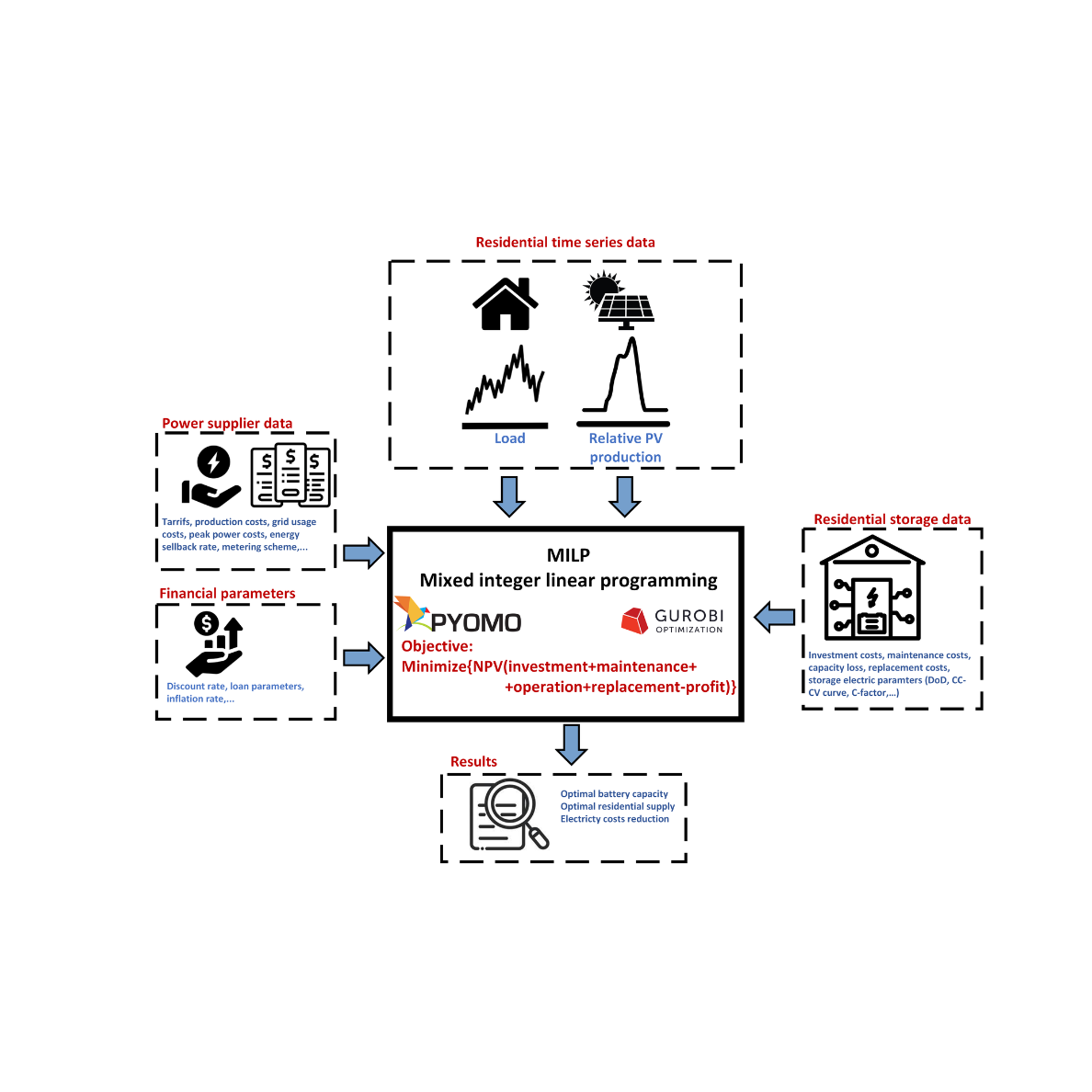
As residential photovoltaic (PV) systems continue to increase, integrating battery storage emerges as a critical strategy for enhancing system efficiency and grid stability. This paper underscores the significance of incorporating battery storage in grid-connected residential PV systems. Specifically, it delves into the optimal sizing of battery storage for homes equipped with PV plants. Through an extensive investigation, the paper investigates the impact of varying energy sellback prices, different net metering/billing schemes, and battery storage investment costs on the determination of optimal battery capacity for residential consumers. To address this complex optimization challenge, a mixed integer linear program (MILP) model is formulated, providing a systematic framework for decision-making. These findings offer valuable insights into the interplay between financial incentives, regulatory mechanisms, and technological factors in shaping the optimal configuration of residential PV battery systems.
SST 2024 : Evaluating Battery Storage in Residential PV Systems
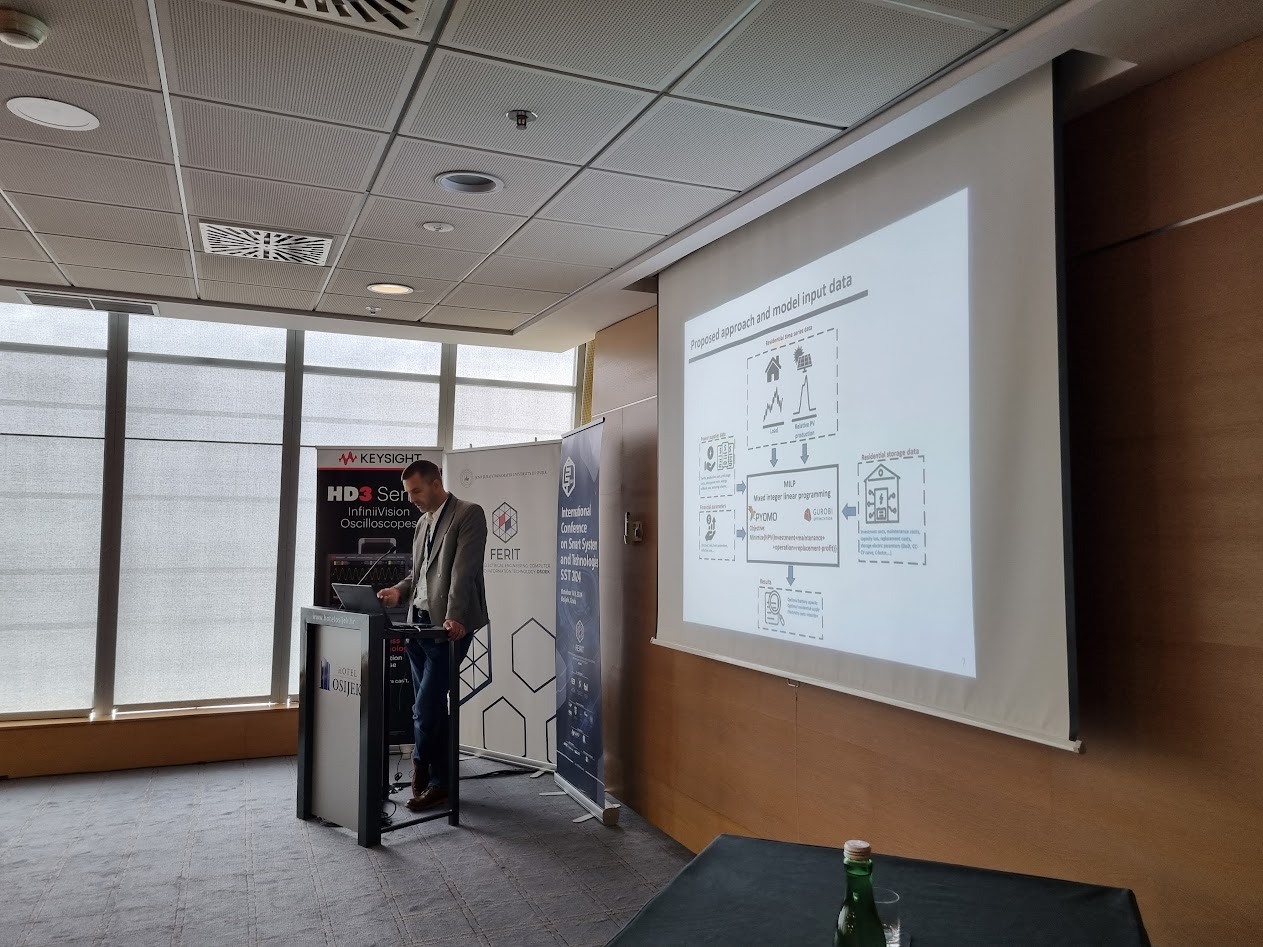
This talk, presented by Damir Jakus and co-authored by experts from FESB, Split, Croatia, explores how varying energy sellback prices, net metering/billing schemes, and battery storage investment costs influence the optimal sizing of battery storage in residential photovoltaic (PV) systems.
Key discussion points include:
- Insights from a mixed integer linear programming (MILP) model for battery optimization
- Case studies from Croatia, highlighting different net metering/billing schemes
- The potential for battery integration to reduce energy costs under varying conditions
As the adoption of residential PV systems continues to rise, battery storage has become an essential component for enhancing energy efficiency and grid stability. This session delves into the core factors that influence the optimal sizing of battery storage, focusing on key elements such as:
- Energy Sellback Rates: How varying rates for selling excess energy back to the grid can impact the economic feasibility of battery storage. Net Metering and Billing Schemes: An exploration of monthly net metering/billing versus 15-minute interval net billing, with case studies from Croatia that reveal how these schemes affect both residential and business consumers.
- Battery Storage Investment Costs: Analysis of how declining battery storage costs are reshaping the energy landscape and the implications for residential PV systems. Optimization Model: An introduction to the mixed integer linear programming (MILP) model developed to optimize battery capacity in grid-connected PV systems, offering a systematic framework for decision-making.
This session provides valuable information for policymakers, engineers, and homeowners interested in optimizing residential solar energy systems. Do not miss this opportunity to deepen your understanding of the intersection between renewable energy technology and financial incentives.
Solar Irradiation High-Frequency Simulation Model" - Prof. Josip Vasilj, PhD
Abstract
This paper presents a high-resolution solar radiation model essential for modern power systems with significant renewable energy integration. Given the unavailability or low temporal resolution of site-specific measurements, the model simulates high-resolution solar irradiation data necessary for planning and analysis. The model employs statistical methods, particularly Beta distributions, to generate realistic one-minute resolution solar irradiation time series, preserving both the probability density and autocorrelation structure of the measured data. Validation shows that the simulated data closely match the statistical properties of the actual measurements, providing a practical tool for scenarios where high-resolution solar data are scarce.
SST 2024 : Solar Irradiation High-Frequency Simulation Model
Presented by Josip Vasilj and a distinguished team from the University of Split, this talk introduces a high-resolution solar irradiation model designed to simulate minute-by-minute solar data. This model is vital for locations where high-frequency solar data is unavailable, providing power system planners and operators with the tools to predict solar energy output accurately and manage grid operations more effectively.
- Innovative Methodology: Learn about the statistical methods, including Beta distributions and autoregressive models, that make this model capable of generating realistic high-frequency solar irradiation data.
- Model Validation: Discover how the simulated data closely mirrors actual measurements, making this model a practical alternative for power systems that rely on renewable energy sources like solar power.
- Applications: Understand the implications of this model for grid stability, energy storage integration, and demand response strategies, all of which are critical for advancing renewable energy adoption.

Damir Jakus
Full Professor | Department of Power Grids and Substations
Researcher and a full professor at the Faculty of Electrical Engineering, Mechanical Engineering and Naval Architecture in Split. His research interests include power system optimization and planning, RES integration, electricity market modeling.