Abstract
In this paper, a 3D quasistatic numerical algorithm for computation of the electric field produced by overhead power lines is presented. The real catenary form of the overhead power line phase conductors and shield wires is taken into account with an arbitrary number of straight thin-wire cylindrical segments of active and passive conductors. In order to obtain more precise results of the charge density distribution, segmentation is conducted for each overhead power line span separately. Moreover, the presence of the towers which distort the electric field and significantly reduce its magnitude is taken into account. Therefore, the towers of overhead power lines are approximated using thin-wire cylindrical segments of passive conductors with electric potential equal to zero. From self and mutual coefficients of these components, system of linear equations for computation of the charge density distribution was obtained. In the numerical example, electric field intensity distribution in the vicinity of towers and under the midspan of overhead power lines is shown. In order to verify the accuracy of the presented model, the obtained results are compared with similar published examples and results available in the literature.

Tonći Modrić
Associate Professor | Department of Electrical Intallations and Systems
Researcher and Full Professor at the Faculty of Electrical Engineering, Mechanical Engineering, and Naval Architecture in Split. His research focus is numerical modeling and calculation of the electric and magnetic fields in power systems and transmission lines, with an emphasis on the development of advanced models for interpreting geoelectrical ground survey data. Additionally, he is involved in the analysis of electromagnetic transients in systems with a high share of renewable energy sources, using finite element techniques.
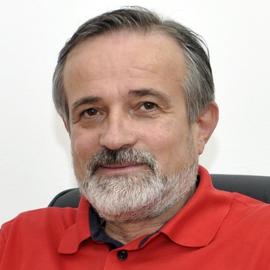
Slavko Vujević
Professor Emeritus
An expert in electrical engineering, particularly known for his contributions to numerical modeling of electromagnetic phenomena, lightning protection, and grounding. Throughout his career, he was a key member of the Faculty of Electrical Engineering, Mechanical Engineering, and Naval Architecture in Split, where he taught, mentored students, and actively participated in scientific research and international professional organizations.