Abstract
In this paper, analytical expressions for a highly accurate computation of Carson formulas are developed. Highly accurate analytical expressions for per-unit-length (pul) self and mutual impedance corrections are now reduced to two linear combinations of 50 functions. Coefficients of these linear combinations are computed using exponential approximation of integrals’ kernel function. Proposed algorithm has simplified computation in comparison with other highly accurate numerical algorithms. Results computed by proposed algorithm and by two approximation methods are compared with 7 digit accurate results computed by piecewise quadratic approximation for large frequency range.

Ivan Krolo
Assistant Professor | Department of Theoretical Electrical Engineering and Modelling
Researcher and assistant professor at the Faculty of Electrical Engineering, Mechanical Engineering, and Naval Architecture in Split, with research focus on the development of numerical models for grounding systems and issues related to electrical safety in low-voltage and high-voltage systems.
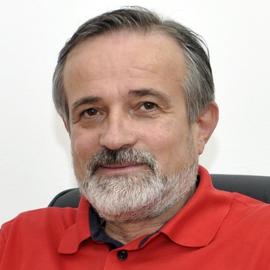
Slavko Vujević
Professor Emeritus
An expert in electrical engineering, particularly known for his contributions to numerical modeling of electromagnetic phenomena, lightning protection, and grounding. Throughout his career, he was a key member of the Faculty of Electrical Engineering, Mechanical Engineering, and Naval Architecture in Split, where he taught, mentored students, and actively participated in scientific research and international professional organizations.

Tonći Modrić
Associate Professor | Department of Electrical Intallations and Systems
Researcher and Full Professor at the Faculty of Electrical Engineering, Mechanical Engineering, and Naval Architecture in Split. His research focus is numerical modeling and calculation of the electric and magnetic fields in power systems and transmission lines, with an emphasis on the development of advanced models for interpreting geoelectrical ground survey data. Additionally, he is involved in the analysis of electromagnetic transients in systems with a high share of renewable energy sources, using finite element techniques.