Non-iterative algorithm for computation of the prospective permissible touch voltage according to EN 50522
Abstract
The prospective permissible touch voltage computation algorithm can be found in the international standards and technical specifications. By combining values of the total human body impedance and values of the permissible body current, extracted from tables and figures, the relevant permissible touch voltage as a function of the fault duration is obtained using an iterative process. In this paper, a simple and robust non-iterative algorithm for computation of the prospective permissible touch voltage according to EN 50522 for chosen fault duration is presented. In proposed algorithm, computation of the prospective permissible touch voltage is reduced to linear combination of permissible touch voltage for a current path hand to hand and permissible body current. For chosen fault duration, permissible touch voltage for a current path hand to hand and permissible body current are computed using piecewise cubic Hermite interpolation and given sampled values of these functions and sampled values of their derivatives with respect to fault duration.
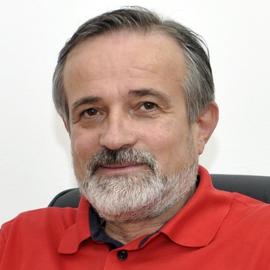
Slavko Vujević
Professor Emeritus
An expert in electrical engineering, particularly known for his contributions to numerical modeling of electromagnetic phenomena, lightning protection, and grounding. Throughout his career, he was a key member of the Faculty of Electrical Engineering, Mechanical Engineering, and Naval Architecture in Split, where he taught, mentored students, and actively participated in scientific research and international professional organizations.

Tonći Modrić
Associate Professor | Department of Electrical Intallations and Systems
Researcher and Full Professor at the Faculty of Electrical Engineering, Mechanical Engineering, and Naval Architecture in Split. His research focus is numerical modeling and calculation of the electric and magnetic fields in power systems and transmission lines, with an emphasis on the development of advanced models for interpreting geoelectrical ground survey data. Additionally, he is involved in the analysis of electromagnetic transients in systems with a high share of renewable energy sources, using finite element techniques.