The Influence of Conductive Passive Parts on the Magnetic Flux Density Produced by Overhead Power Lines
Abstract
There has been apprehension about the possible adverse health effects resulting from exposure to power frequency magnetic field, especially in the overhead power lines vicinity. Research work on the biological effects of magnetic field has been substantial in recent decades. Various international regulations and safety guidelines, aimed at the protection of human beings, have been issued. Numerous measurements are performed and different numerical algorithms for computation of the magnetic field, based on the Biot-Savart law, are developed. In this paper, a previously developed 3D quasistatic numerical algorithm for computation of the magnetic field (i.e. magnetic flux density) produced by overhead power lines has been improved in such a way that cylindrical segments of passive conductors are also taken into account. These segments of passive conductors form the conductive passive contours, which can be natural or equivalent, and they substitute conductive passive parts of the overhead power lines and towers. Although, their influence on the magnetic flux density distribution and on the total effective values of magnetic flux density is small, it is quantified in a numerical example, based on a theoretical background that was developed and presented in this paper.
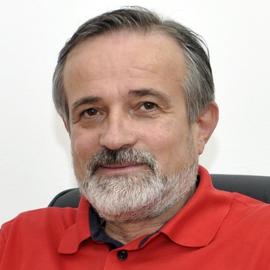
Slavko Vujević
Professor Emeritus
An expert in electrical engineering, particularly known for his contributions to numerical modeling of electromagnetic phenomena, lightning protection, and grounding. Throughout his career, he was a key member of the Faculty of Electrical Engineering, Mechanical Engineering, and Naval Architecture in Split, where he taught, mentored students, and actively participated in scientific research and international professional organizations.

Tonći Modrić
Associate Professor | Department of Electrical Intallations and Systems
Researcher and Full Professor at the Faculty of Electrical Engineering, Mechanical Engineering, and Naval Architecture in Split. His research focus is numerical modeling and calculation of the electric and magnetic fields in power systems and transmission lines, with an emphasis on the development of advanced models for interpreting geoelectrical ground survey data. Additionally, he is involved in the analysis of electromagnetic transients in systems with a high share of renewable energy sources, using finite element techniques.