Wind Energy Conversion System Using Advanced Speed Control and Model-Based Loss Minimization
Abstract
This paper presents a new optimization strategy for a stand-alone wind energy conversion system (WECS). The WECS is comprised of a variable-speed wind turbine (WT) with a vector- controlled self- excited induction generator (SEIG), a three-phase full-bridge converter, and a DC-bus containing the excitation capacitor, batteries, and a load. The control strategy incorporates an advanced model- based SEIG loss minimization and fuzzy-logic WT optimization. The latter utilizes a hedge-algebra speed controller to ensure fast response with practically no overshoot in the whole WT operating range, which cannot be achieved with the conventional proportional-integral (PI) controller. Consequently, the WT optimization time step is shortened and its convergence accelerated. The proposed SEIG loss minimization is based on the corresponding mathematical model that accounts for magnetic saturation and variable stray load and iron losses. Simultaneous optimization of the WT and SEIG is enabled, which results in greater total energy output compared to the successive WT- SEIG optimization. The proposed control strategy is run in real-time using the DS1103 board (dSpace) with a 1.5 kW SEIG driven by an emulated WT. It is experimentally evaluated over a wide WT operating range and compared with several competing strategies involving successive optimization, PI speed control and/or less elaborate SEIG models.
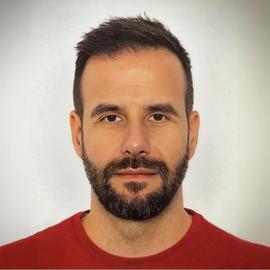
Mateo Bašić
Full Professor | Department of Power Electronics and Control
Full professor at the Faculty of Electrical Engineering, Mechanical Engineering and Naval Architecture in Split, with recent research interests related to the fields of power electronics and renewable energy sources, with a special focus on energy-efficient control of inverters, battery systems, wind turbines, photovoltaic sources and self-excited induction generators in microgrids - both in island operation and in grid-tie operation.
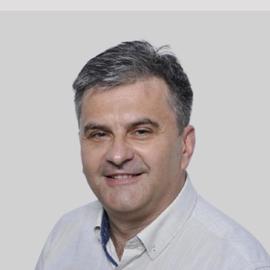
Dinko Vukadinović
Full Professor | Department of Power Electronics and Control
Full professor at the Faculty of Electrical Engineering, Mechanical Engineering, and Naval Architecture in Split, specialized in modern control systems for power electronic converters, electric motors, and generators. At the Power Electronics Research Laboratory, he leads experimental projects and develops advanced methods for regulating electrical machines and converters, while supervising doctoral research in these areas.
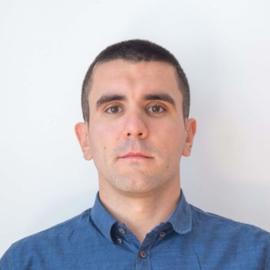
Ivan Grgić
Assistant Professor | Department of Power Electronics and Control
Assistant professor at the Faculty of Electrical Engineering, Mechanical Engineering and Architecture in Split, specialized in the research of power electronic converters in photovoltaic systems and microgrids. Currently, he teaches courses in the areas of control engineering, digital electronics, electrical engineering, electrical machines and transformers.