A combined analysis of earthing grids in karstic soil
Abstract
This paper presents the theoretical basis for the optimal calculation of the stationary current field of mesh earthing conductors of a high-voltage electrical installation. The core of the paper is represented by three originally developed mathematical and numerical models. In Chapter 2, a mathematical and numerical model for the interpretation of data measured by geoelectrical sounding methods using direct or low-frequency current is described. Based on the data measured for one sounding point, the soil is replaced by a multilayer model with uniform characteristics in the horizontal direction, where the total number of layers is chosen arbitrarily. The interpretation is fully automated, and can be performed by a direct procedure, an iterative procedure, or a combination thereof. The direct and iterative interpretation are based on the analysis of the transformed resistivity function, which is directly related to the characteristics of the multilayer soil model. The transformed resistivity function is calculated from the measured data on the basis of analytical integration with a previous numerical approximation of the Stefanescu kernel function by a linear combination of up to 16 exponential functions. Using the same expressions, the apparent resistivity function is also calculated from the characteristics of the given soil model. Automatic direct interpretation is performed in such a way that the characteristics of the soil model layers are determined gradually layer by layer based on the approximation of the first part of the transformed resistivity curve, calculated from the measured data, using the curve of the two-layer model. After the characteristics of a layer have been determined, using the Pekeris recursive expression, the considered uppermost layer in the reduced soil model is discarded. Automatic iterative interpretation is based on the comparison of the sampled values of the transformed resistivity function of the model with the values calculated from the measurements. With an arbitrarily chosen total number of layers, the optimal characteristics of the soil model are calculated using the least squares method. The resulting system of nonlinear equations is iteratively solved using a variant of the Marquardt method, which converges quickly and reliably. In combined automatic interpretation, the model characteristics calculated by the direct method are used as initial characteristics in the iterative interpretation procedure. In Chapter 3, a mathematical and numerical model for the calculation of mesh earth electrodes laid in a multilayer soil with uniform characteristics in the horizontal direction is described. The procedure is based on the integral formulation of the problem. The total number of layers of the soil model as well as the total number of metallically separated earth electrodes is completely arbitrary. A single earth electrode can extend through multiple layers. The earth electrode conductors are divided into segments, and the line current density and potential of a single segment are approximated by the mean potential method. The generality and efficiency of the calculation procedure is achieved thanks to the successful application of the numerical approximation of two kernel functions of the integral expression for the potential distribution within the boundaries of one layer, which is caused by the current of a point source. Each kernel function is approximated by a linear combination of 15 exponential functions. The algorithm for determining the unknown coefficients of the linear combination is maximally simplified by reducing it to the multiplication of a known constant pseudo-inverse matrix and sampled values of the kernel function under consideration. This is followed by a simple analytical integration using the Lipschitz integral. From a point source to a segment of the earthing conductor, integration is performed using a line source, which is assumed to be located in the axis of the segment. This calculation procedure represents a major advance in the field of calculation of the stationary current field of mesh earthing conductors. Its use achieves results of a high degree of accuracy in a short calculation time. In Chapter 4, a mathematical and numerical model is described for the calculation of mesh earthing conductors placed in a complex soil model, which can well approximate extremely heterogeneous soil such as karst soil. The procedure is based on the application of the finite element technique to a combination of differential and integral formulation of the problem. The three-dimensional calculation area is divided, using the finite element technique, into a small number of huge (subparametric) finite and infinite elements. Within one finite element, there can be several conductors, even the entire network of a single earthing conductor. The total number of metallically separated earthing conductors is completely arbitrary. The earthing conductors are divided into segments, while the approximation of the line current density and the potential of the segment is carried out by the mean potential method. The potential approximation function is built separately for each finite or infinite element. The combined procedure for calculating the earthing conductor is feasible on a personal computer with at least 16 Mb of RAM memory. Real examples of calculations can be performed in a relatively short computational time. Given the universality of numerical methods, all developed numerical procedures can be successfully applied in the research and solution of a number of problems in various branches of technology. Of particular importance are: an original way of solving the problem of a mesh source in a multilayer medium, an original way of solving the problem of a mesh source in a highly heterogeneous medium, and an effective combination of two different approaches in the finite element technique. Given the universality of numerical methods, all developed numerical procedures can be successfully applied in the research and solution of a number of problems in various branches of technology. Of particular importance are: an original way of solving the problem of a mesh source in a multilayer medium, an original way of solving the problem of a mesh source in a highly heterogeneous medium, and an effective combination of two different approaches in the finite element technique.
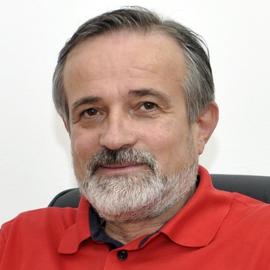
Slavko Vujević
Professor Emeritus
An expert in electrical engineering, particularly known for his contributions to numerical modeling of electromagnetic phenomena, lightning protection, and grounding. Throughout his career, he was a key member of the Faculty of Electrical Engineering, Mechanical Engineering, and Naval Architecture in Split, where he taught, mentored students, and actively participated in scientific research and international professional organizations.