Synchronous hydro-generator parameter identification based on on-line measurements
Abstract
This dissertation defines a methodology for identifying the parameters of a synchronous hydrogenerator during operation, based on measurements available within the hydrounit monitoring system at the Peruca HPP. The identification process uses data from recorded responses of generator variables in the small displacement regime, in quasi-stationary and transient states, with the application of appropriate estimation models and procedures. The identification process is divided into three steps, and the theoretical verification of each step, based on appropriate simulation responses, gave very good results for all parameters of the standard mathematical model of a synchronous hydrogenerator. For the identification of synchronous machine parameters based on measurements in operation, it is very important to accurately measure the load angle, to which one chapter of this paper is dedicated. A new method for determining the load angle is presented, which is based on measuring the armature voltage signal and the signal from the machine air gap sensor. An algorithm for determining the load angle in real time (on-line) has been developed, and its off-line variant is intended for carrying out the identification process. Since the identification of parameters does not require real-time processing, it was possible to apply subsequent digital signal filtering, which increased the accuracy of the algorithm. After theoretical testing, the validity of the proposed algorithm was verified by comparison with the procedure for determining the load angle based on measuring the rotor position using an inductive sensor. In the first step of the identification procedure, the parameters of the armature winding are determined. First, the leakage reactance of the armature winding is determined, for which there is no standard procedure yet. The paper uses a method based on measuring the induction in the air gap in no-load and short-circuit tests. A new procedure for determining the synchronous reactances of generators is defined, which requires only measurements in stationary operation, which was possible thanks to a special procedure for determining the reduction factor. The results of reactance measurements in a series of stationary points served as the basis for developing a machine saturation model. The model is defined in analytical form, where the synchronous reactances are defined as polynomials of two variables – magnetomotive forces in the longitudinal and transverse axes of the machine. The developed saturation model also includes the effect of transverse magnetization. Experimental verification of the model in the steady state was carried out based on measurements on a 34 MVA generator in the Peruca HPP. The developed saturation model was implemented in a standard mathematical model of the generator, which resulted in a saturated synchronous machine model. The estimation models for the second and third identification steps were corrected based on the developed generator saturation model. Based on the conducted analyses, it was shown that there is a large influence of saturation on the reliability of the estimation, especially in the third identification step in which the choke winding parameters are determined. Contrary to the results that can be found in the literature, it is shown that reliable identification of choke winding parameters based on the response in the small displacement regime is not possible. As for the second identification step, i.e. determination of the excitation winding parameters, the reliability of the procedure strongly depends on the noise level. Therefore, an alternative procedure was developed in which the application of the estimation algorithm was bypassed. The procedure was tested with appropriate measurements, resulting in satisfactory parameter accuracy and robustness of the procedure to measurement noise.
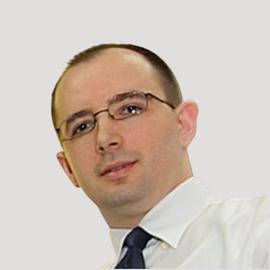
Marin Despalatović
Full Professor | Department of Electrical Drives and Industrial Control
Full professor at the Faculty of Electrical Engineering, Mechanical Engineering, and Naval Architecture in Split, where he teaches courses Electric Machines, Electric Drive Systems, and Electromechanical System Modeling. His research focuses on power systems, energy storage, and smart grid technologies, with active participation in multiple national and international projects aimed at advancing energy infrastructure and improving system stability.