Control systems of a photovoltaic-fed quasi-Z-source inverter with a novel pulse-width modulation
Abstract
This doctoral dissertation presents three new control systems with a quasi-Z-type inverter powered by a photovoltaic source. The first system is battery-free and the inverter operates in grid connection, while the other two systems are battery-operated and the inverter operates in one case in grid connection and in the other in island mode. A new pulse-width modulation was used to control the quasi-Z-type inverter, with an added third harmonic and an implemented dead time, in which the start of the firing state is synchronized with the start of the zero state and which results in a significant reduction in semiconductor losses. Two new algorithms for calculating semiconductor losses of a quasi-Z-type inverter controlled by the new pulse-width modulation were developed, the accuracy of which was experimentally verified. The first new control system with a quasi-Z-type inverter powered by a photovoltaic source and connected to the electrical grid ensures tracking of the maximum power point without oscillations and without measuring the current of the photovoltaic source. The simulation analysis of this system was performed for a new dynamic model of a photovoltaic source with two diodes and taking into account the effect of the depletion region capacity and the diffusion capacity of each diode. The second new regulation system with batteries assisted by a quasi-Z-type inverter in island mode uses the battery current instead of the source current to search for the maximum power point of the photovoltaic source, while the third new regulation system with batteries assisted by a quasi-Z-type inverter, in grid mode, uses the d-component of the grid current vector for the same purpose. Experimentally confirmed transfer functions obtained based on a new linearized average mathematical model of the system were used to synthesize both battery-based regulation systems.
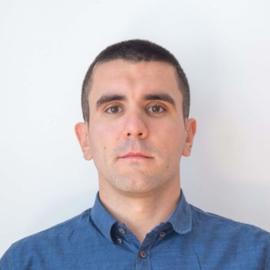
Ivan Grgić
Assistant Professor | Department of Power Electronics and Control
Assistant professor at the Faculty of Electrical Engineering, Mechanical Engineering and Architecture in Split, specialized in the research of power electronic converters in photovoltaic systems and microgrids. Currently, he teaches courses in the areas of control engineering, digital electronics, electrical engineering, electrical machines and transformers.