Dynamic Equivalent Circuit Models of Lead-Acid Batteries – A Performance Comparison
Abstract
This paper presents a performance comparison of the four most commonly used dynamic models of lead-acid batteries that are based on the corresponding equivalent circuit. These are namely the Thevenin model, the dual polarization (DP) model (also known as the improved Thevenin model), the partnership for a new generation of vehicle (PNGV) model, and the general non-linear (GNL) model. The equivalent circuit models (ECMs) are widely used for modeling, simulation, and state- of-charge (SOC) estimation of battery systems due to the fact that the physical variables in ECMs are easily understood and intuitive. The parameters of the ECMs may be modeled as constant or as dependent on the battery condition indicators, such as the SOC, temperature, state of health (SOH), operating regime, etc. In this study, the values of the ECM parameters have been determined from the pulse-charge and pulse discharge tests conducted at five different SOC levels within the range 50%-90% and then approximated by second order polynomial functions. The corresponding simulation models have been developed in the MATLAB Simulink environment, whereas their accuracy has been evaluated based on the comparison with the experimental results acquired and processed by means of the DS1104 controller board (dSpace).

Mateo Bašić
Full Professor | Department of Power Electronics and Control
Full professor at the Faculty of Electrical Engineering, Mechanical Engineering and Naval Architecture in Split, with recent research interests related to the fields of power electronics and renewable energy sources, with a special focus on energy-efficient control of inverters, battery systems, wind turbines, photovoltaic sources and self-excited induction generators in microgrids - both in island operation and in grid-tie operation.
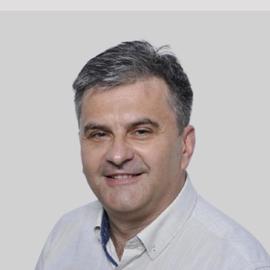
Dinko Vukadinović
Full Professor | Department of Power Electronics and Control
Full professor at the Faculty of Electrical Engineering, Mechanical Engineering, and Naval Architecture in Split, specialized in modern control systems for power electronic converters, electric motors, and generators. At the Power Electronics Research Laboratory, he leads experimental projects and develops advanced methods for regulating electrical machines and converters, while supervising doctoral research in these areas.